I still remember the annual reporting season three years ago, when game companies released one dismal 2021 earnings report after another. The bleak figures made even an outside observer like me feel the industry’s grim atmosphere. I therefore wrote an article titled “Game Companies’ Earnings Previews: Just Like My Report Card Full of Failing Grades” to analyze the industry’s performance.

Three years have flown by in the blink of an eye, and the gaming industry has undergone a complete transformation.
As interim reports are being released one after another, Game Tea House is pleased to see that most listed game companies have achieved solid results in this year’s mid-year “exams”: seven companies have turned a profit, six have forecast profit growth, and one has narrowed its losses.

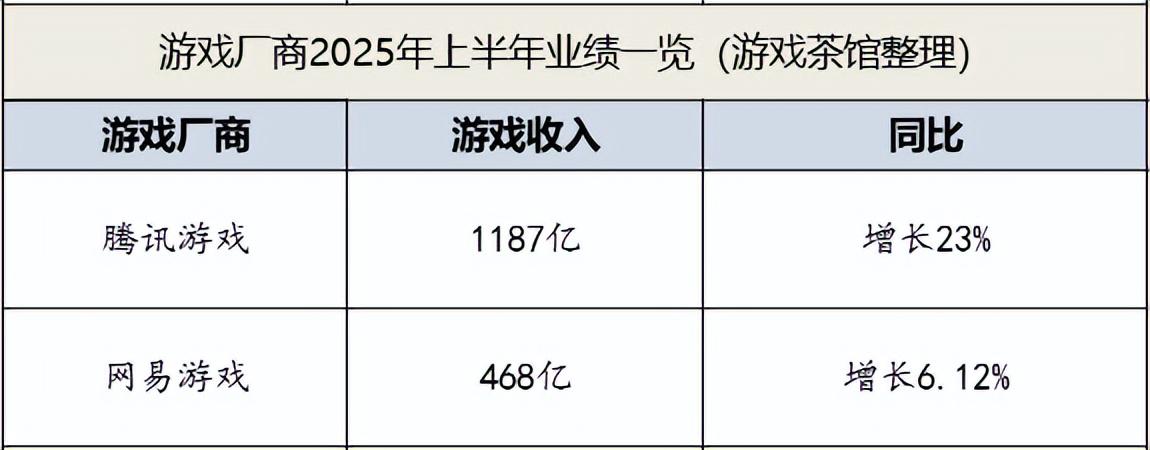
Turning to the two giants, Tencent and NetEase, their performance in the first half of the year was also very strong.
NetEase Games reported first-half revenue of 46.8 billion yuan, a year-over-year increase of 6.12%, setting a new record high. Long-running titles such as *Fantasy Westward Journey* and *Identity V* performed exceptionally well.
Tencent Games’ revenue reached 118.7 billion yuan in the first half of the year. Achieving a 23% growth rate with such a massive scale is truly a testament to the company’s agility. Even when focusing solely on Tencent’s domestic game market revenue (83.3 billion yuan), the growth rate still stood at 20.55%.
The recovery in performance among listed game companies suggests that the gaming industry has emerged from its previous contraction cycle and is steadily climbing toward a new level.
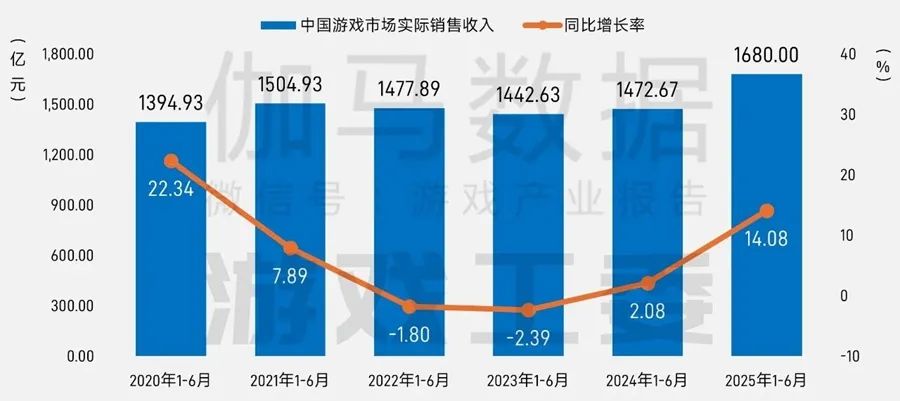
If listed game companies serve as a barometer for the health of large and medium-sized developers, the "January–June China Game Industry Report" recently released by the China Game Industry Committee reveals that the domestic game market grew by 14.08% year-over-year—the highest growth rate in nearly five years. These macro-level figures confirm that the gaming industry has once again entered a long-awaited growth window.
After three years, the gaming industry has finally weathered the long night.
01
Gaming Stocks Lead Gains Across All Sectors; Venture Capitalists Are Turning Their Attention Back to Gaming
A review of recently released earnings forecasts by Game Tea House reveals that most companies have achieved profitability in their gaming operations thanks to the strong performance of newly launched titles and cost-cutting and efficiency-enhancing measures on the cost side, thereby driving an overall increase in corporate profits.
Let’s take a look at several representative companies:
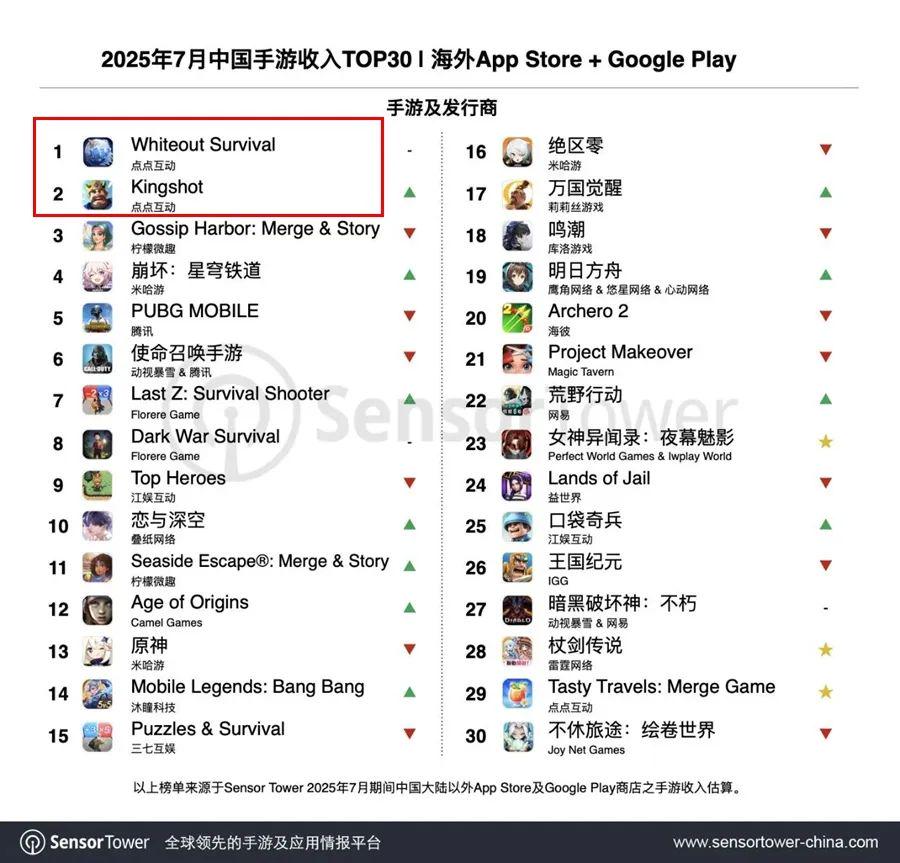
Century Huatong, which has doubled its net profit, continues to rake in substantial revenue both domestically and internationally through its subsidiary DianDian Interactive’s phenomenon-level game *Endless Winter*, maintaining steady growth. Meanwhile, its new title *Kingshot* has also made a striking debut overseas, ranking third in overseas revenue and emerging as the undisputed star of the moment. Since the start of this year, Century Huatong’s stock price has surged by 174%.
Xindong: Starting last year, the company’s self-developed games—which have been in development for years—finally entered their harvest phase. According to earnings forecasts, games such as *Xindong Town*, *Ragnarok M: First Love Server*, and *Torchlight: Infinite* performed strongly in the market during the reporting period. Meanwhile, revenue and profits from TapTap continued to grow, driving the company’s overall profit growth by 215%.
Perfect World, which has seen significant management changes in recent years, has finally turned a profit. *Zhu Xian World*, which entered open beta at the end of last year, “contributed to solid revenue growth” in the first half of the year, while cost-cutting and efficiency improvements began to bear fruit. Perfect World’s gaming business recorded a non-GAAP net profit of 320–360 million yuan.
It is evident that game developers achieved higher-quality profits in the first half of the year, rather than relying on non-recurring gains—such as the sale of subsidiaries or the appreciation of financial assets—to achieve overall profitability, as was previously the case. For example, one game developer achieved overall profitability in 2024 largely due to substantial gains from its fund holdings during a major stock market rebound.
As the saying goes, "Ducks are the first to sense the warmth of spring in the river," investors in the secondary market have been quick to capture the growth trends in the gaming industry. So far this year, gaming ETFs have risen by over 38%, significantly outperforming the CSI 300 Index (7.3%) and many other sectors, second only to the hottest sectors—the innovative drug index and the telecommunications equipment index.
The primary market has also seen increased activity.
Earlier, financial media reported that ByteDance planned to bundle Zhaoxi Guangnian and Mooton for a standalone IPO. Subsequently, it was reported that Mooton had acquired Xinguang Liumei, the developer of *High-Energy Figurine Squad*. According to Game Tea House, Mooton’s pursuit of mergers and acquisitions with mid-sized game companies is no secret within the gaming investment community.
At the same time, Game Tea House has observed a recent increase in the number of investors evaluating game development teams. These include not only industry-specific venture funds but also M&A capital from outside the sector.
In the past two years, many established industry veterans have returned to the scene, setting up their own industrial funds to support the gaming industry in a different capacity.

In addition to Shen Li’s L3, there is also Yuan Jing’s Pilot
On another front, since the China Securities Regulatory Commission (CSRC) issued the “Nine Measures on M&A” last year, some A-share listed companies have begun acquiring profitable game companies to boost their own earnings. This may potentially raise the valuation levels of game developers.
While we won’t see the massive investment volumes of 2020, overall investment is gradually increasing.
02
946 game licenses have been approved this year, with 7 provinces and municipalities introducing policies to support the gaming industry
In the not-so-distant year of 2021, the gaming industry faced a rather challenging external environment.
Central and local media joined forces to criticize the industry for its ineffective anti-addiction measures; gaming regulators suspended game version number approvals and summoned several leading game developers for discussions. In the first half of the year, the gaming industry was still regarded as an important cultural medium, but by the second half, it had been labeled “spiritual opium.”
After 2022, due to changes in the domestic and international environment, restrictive policies gradually gave way. Having rectified and implemented anti-addiction measures, the gaming industry has reorganized and set out anew.
Since the resumption of game version number approvals in 2022, the number of approved games has increased year by year. From January to July of this year, the National Press and Publication Administration has issued 946 game version numbers, a year-on-year increase of 19.29%. Among these, the number of version numbers for domestically produced games has grown significantly, with 884 issued so far this year, representing a year-on-year increase of 20.60%.

On the other hand, society as a whole has set aside its prejudices and come to recognize the role of games as an important cultural medium. In particular, after *Black Myth: Wukong* broke through niche boundaries to achieve unprecedented success, it has become a flagship example of cultural exports.
Local governments have recognized that games not only generate employment and tax revenue but also foster industrial clustering, create brand effects, and enhance a city’s reputation. Just as mentioning *Genshin Impact* naturally brings Shanghai to mind; discussing *Black Myth: Wukong* inevitably leads to Hangzhou; and when *Ne Zha: The Demon Boy* is mentioned, Chengdu also comes to the table…

Since last year, the central government and seven provincial and municipal governments have introduced policies to provide tangible financial support for the gaming industry:
- In March of this year, the State Council’s “Special Action Plan to Boost Consumption” explicitly included games, esports, and related merchandise within the scope of policy support, requiring the integration of China’s excellent traditional culture into game design and supporting the development of original IPs.
- In May, four departments—including the Ministry of Commerce and the Publicity Department of the CPC Central Committee—added 98 gaming companies, such as Tencent, NetEase, and miHoYo, along with 15 games including *Genshin Impact*, to the National Cultural Export List, providing support for their global expansion.
- In March of this year, Beijing’s Shijingshan District announced a one-time subsidy of 300,000 yuan for original games, with R&D support reaching up to 15 million yuan.
- Shanghai issued a document proposing to pilot a policy at an appropriate time that treats game products developed in Shanghai by foreign-invested game companies as domestic games.
- In May, Guangdong Province released a policy package to support the innovative development of the gaming industry. The policies focus on supporting original high-quality works and technological innovation, optimizing the business environment, building industrial clusters, improving support systems, and strengthening service guarantee mechanisms. They propose providing a one-time support grant of up to 5 million yuan for high-quality projects with both strong cultural dissemination and social influence; and a one-time support grant of up to 5 million yuan for high-quality projects that achieve significant breakthroughs in gaming technology.
- Recently, Shenzhen issued a notice to vigorously develop industries such as games, film, and animation. It provides funding of up to 10 million yuan—not exceeding 30% of the investment—for game products that reach a certain scale and demonstrate strong social benefits and dissemination effects; it also offers up to 500,000 yuan in funding for native HarmonyOS game applications that have been developed and launched.
- The Hangzhou Municipal Bureau of Commerce has issued a call for public comments, proposing to “seek national support to grant Hangzhou greater autonomy in the online gaming sector and increase the number of game version numbers allocated to Hangzhou.”
- Last year, Chengdu High-Tech Zone released support policies offering rewards of up to 1 million yuan for new games that have obtained a publishing license and gone live, those with over 5,000 overseas testers, and new games launched overseas with annual revenue exceeding 10 million yuan.
- So far this year, companies such as Tap4Fun, Xishanju Shiyou, Star Union Interactive, Zhuohang Network, and Ubisoft Chengdu have applied for these rewards, and the list of recipients has been publicly announced.
- In August, Fuzhou’s Gulou District proposed a one-time reward of 200,000 yuan for new games that have obtained a license and gone live. Original games that win international awards are eligible for a 200,000-yuan reward, while those that win domestic awards can receive 100,000 yuan.
These support policies, originating from cities with the highest concentrations of game companies—including Beijing, Shanghai, Guangzhou, Shenzhen, Hangzhou, and Chengdu—can be interpreted as comprehensive support for the entire gaming industry.
03
Confidence is Rebounding, with Impressive New Products Continuously Emerging
Having weathered this contraction cycle in the gaming industry, what Game Tea House feels most acutely is the prolonged lack of confidence within the sector.
Unable to see a clear path forward, developers have continuously lowered their expectations for the future. Due to this uncertainty, companies have canceled projects with weaker competitiveness, reduced hiring quotas, and continued to pursue cost-cutting and efficiency improvements.
This structural imbalance in the gaming industry over the past few years is the root cause of the challenging job market conditions experienced by industry professionals.
Even during this period of strategic retrenchment, developers have actually continued to increase R&D investment, concentrating resources on key projects. The investments made over the past few years have gradually reached new milestones this year.
Flagship sequels such as *Blue Star*, *Loop of Infinity*, and *Arknights: Endland* have demonstrated exceptional quality in their beta tests; the debut trailers for *Infinite*, *Void Loop*, *Return Loop*, and *City of Silver* have generated significant buzz, showcasing immense ambition and the potential to raise the industry’s standards even higher.
The unveiling of high-quality new projects always brings a wave of new job openings.
At the same time, Game Teahouse has observed greater diversification in developers’ new projects. Not only have service-based games been unveiled, but AAA buy-to-play titles are also receiving significant attention. This August alone saw the announcement of major titles like *Mountain Beyond Mountain* and *Gu Jian*, suggesting a promising future.

While the profit potential of AAA single-player titles may not match that of service-based games, they represent the cutting edge of production capabilities, and the success of such a title could greatly boost industry morale.
The emergence of diverse new games, coupled with an ongoing push for higher quality, undoubtedly reflects the industry’s recovering confidence.
04
Back on the Path to Growth
Listed game companies have delivered their strongest mid-year results in nearly five years. Comparatively, it is one of the few sectors in China’s domestic industries still achieving double-digit growth.
While the gaming industry currently faces numerous challenges—such as uncertainty in the domestic market, sluggish hiring demand, and severe product homogenization—it is clear that the most difficult period is long past, and the industry has returned to a growth trajectory.

All that remains is for the market to produce another phenomenon-level hit that charts a new course, just as *Genshin Impact* did back in the day.
原创文章,作者:茶馆小二,禁止转载:https://youxichaguan.com/en/archives/194553